A Local Alternative to CloudConvert, Convertio, and Zamzar for Legacy Lotus Files
Those sites are fine for one modern file. A legacy Lotus folder is a different job.
TL;DR
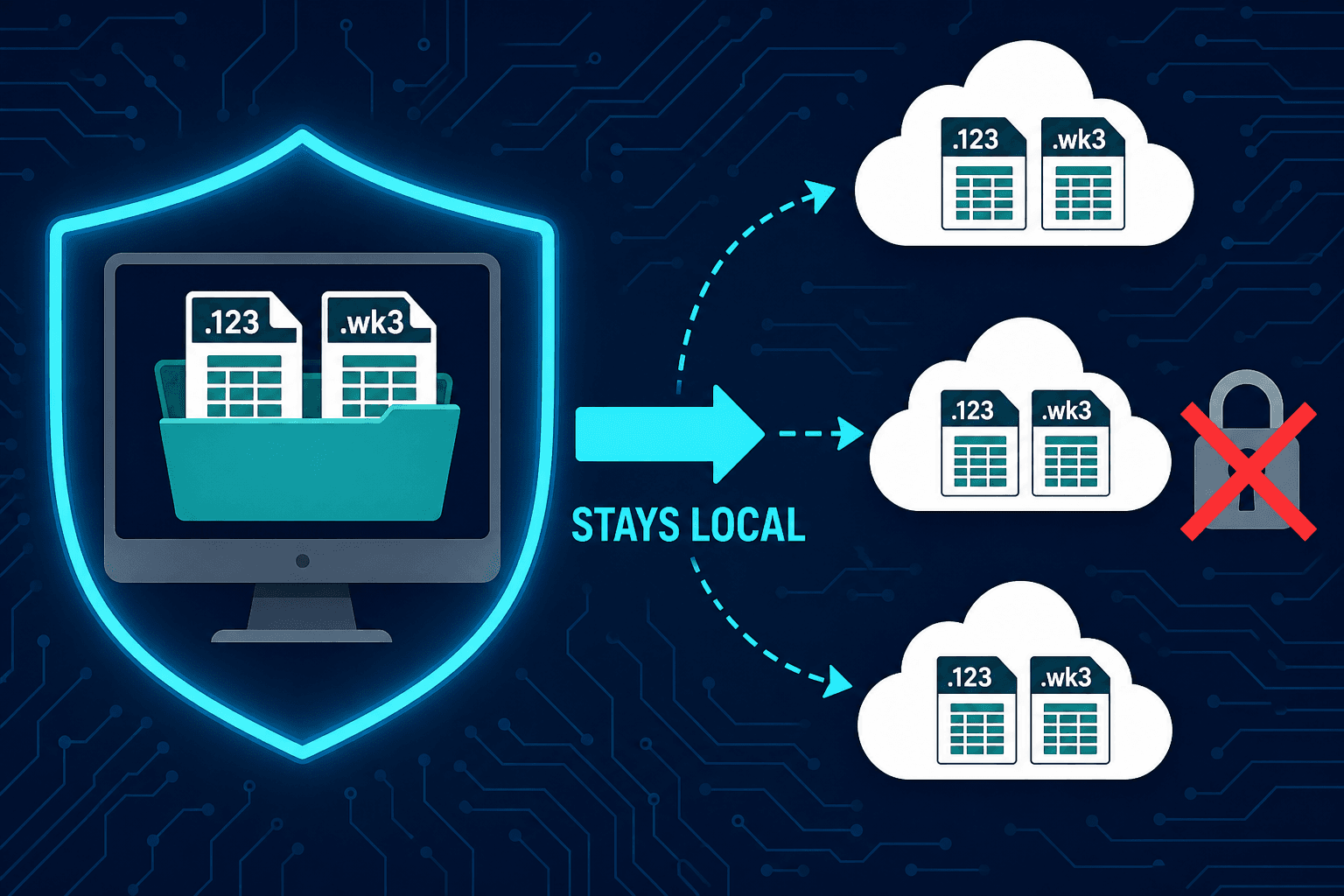
CloudConvert, Convertio, and Zamzar are upload-and-wait converters. They are useful for one modern file. A mixed legacy archive of .123 / .wk* Lotus workbooks is a different job: keep those ledgers on this PC and convert them locally with Lotus Converter. Nothing is uploaded. This is not a slam on those three. It is a different job.
What those three actually are
CloudConvert, Convertio, and Zamzar are web converters. You send a file to their servers. They convert it. You download the result. CloudConvert says the files are processed by machine and deleted within 24 hours. Convertio and Zamzar also convert on their servers. Zamzar, one of the older names in this category, will email you a download link if you give them an address. Paid Zamzar plans also keep converted files in online storage.
That model is convenient when the file is already a modern PDF, a public image, or a single throwaway test document. It is a poor fit for a finance share, a plant cost archive, or a folder of .wk1 / .wk3 / .wk4 / .123 workbooks from 1998.
- CloudConvert — free tier about 10 conversions per day with a 1 GB file size cap; files deleted after about 24 hours; paid plans run on credits. We are not quoting a CloudConvert dollar price here because credit packs vary.
- Convertio — Lite is a monthly subscription, cheaper when billed yearly, with roughly 1 GB and 1,000 credits.
- Zamzar — free tier about 2 conversions per 24 hours; paid plans are three monthly subscription tiers with storage tiers of about 5 GB / 20 GB / 100 GB.
A mixed legacy archive is not one upload
A mixed legacy archive of Lotus files is rarely one neat spreadsheet. It is a folder of .wk1, .wk3, .wk4, and .123 workbooks copied forward through every storage migration—forecasts, pricing, payroll extracts, plant costing, client ledgers.
You do not want to pick twenty workbooks, watch a credit counter, and hope the free daily cap holds. Those limits are fine for a one-off. They are the wrong shape for a mixed legacy archive.
Also: do not assume a general online converter "supports Lotus." CloudConvert's Lotus Word Pro (LWP) pages are a different product from Lotus 1-2-3 spreadsheet formats. Format menus change; inventing support is how archives get mishandled. The question is not whether a landing page lists a Lotus logo. The question is whether you want every legacy file to leave the building.
Why legacy files should stay on this PC
Payroll, pricing, customer lists, and historical financials still live inside many 1990s Lotus workbooks. Sending them to a converter you found in search means a copy exists on a machine you do not own, for some number of hours, under a policy you did not write. Local conversion removes that step. The file goes from old format to new format on the same disk.
If your policy already says sensitive spreadsheets stay on managed endpoints, legacy Lotus files are not an exception just because Excel will not open them.
- Credits and daily caps on a folder of hundreds of workbooks.
- A copy of the archive sitting on someone else's server, even briefly.
- Paid plans that assume you will keep converting in the cloud, month after month.
- Formats that look supported on a landing page and still fail on an old .wk1 or a SmartSuite .123.
What a local Lotus converter does instead
Lotus Converter runs on Windows. You point it at a file or a whole folder. It converts .wk1, .wk3, .wk4, and .123 files to XLSX, PDF, and CSV on this machine—no upload step, no third-party server. The work stays on this PC. You can do it on a machine that is not on the internet.
Keep the originals beside the new copies until you are sure you no longer need them.
1. Add the legacy folder, not one file at a time
Point Lotus Converter at the whole archive (or a sample set of .wk1 / .wk3 / .wk4 / .123 files) sitting on this PC or a mapped share so the batch converts in one pass.
2. Choose modern outputs (XLSX, CSV, or PDF)
Pick XLSX for Excel review, CSV for pipelines and imports, or PDF when you need a fixed snapshot. Outputs land in a folder you control.
3. Convert offline
Run the batch locally. Everything stays on this PC. Nothing is sent to CloudConvert, Convertio, Zamzar, or any other online converter.
When the web tools are still the right tool
If you have one ordinary file, you already know the output format, and nothing in it is private, an online converter is a reasonable choice. Developers who want an API also have reasons to pay CloudConvert credits.
This article is not for that job. It is for the legacy Lotus folder Windows and modern Excel will not open—and that should never leave the network.
Legacy Lotus stays local
CloudConvert, Convertio, and Zamzar convert files you upload. Lotus Converter converts legacy Lotus files you already have, on this PC. Use the first for a one-off modern file. Use the second for the mixed legacy archive of .wk1, .wk3, .wk4, and .123 workbooks.
Related reading
Convert legacy Lotus files on this PC
Try Lotus Converter on a sample folder of .wk1, .wk3, .wk4, or .123 files and keep the conversion offline—no CloudConvert, Convertio, or Zamzar upload.
Free trial
Full app features — up to 10 files
Windows 10 or 11
One offline installer. Same full-feature trial — convert up to 10 Lotus files locally.
Offline MSI · no account required